Introduction
Investment apps and online platforms have made it easier for Nigerians to access different financial products without visiting a traditional investment office.
Depending on the provider, an investor may be able to access products such as shares, mutual funds, bonds, fixed-income investments, savings products or other financial services through a smartphone or computer.
But convenience creates another problem: how do you know whether an investment platform is legitimate before sending money?
A professional-looking website, mobile application, social-media page or WhatsApp account is not enough to prove that an investment business is authorised to provide the service it advertises.
The Securities and Exchange Commission (SEC) has specifically warned Nigerians about unregistered online investment schemes promoted through social media and websites. In a May 2026 public notice, the SEC advised the public not to invest in unregistered online investment platforms or schemes promising unrealistic or guaranteed returns. The Commission also directs investors to verify the registration status of investment platforms and operators before investing.
This makes verification one of the most important steps a Nigerian investor can take.
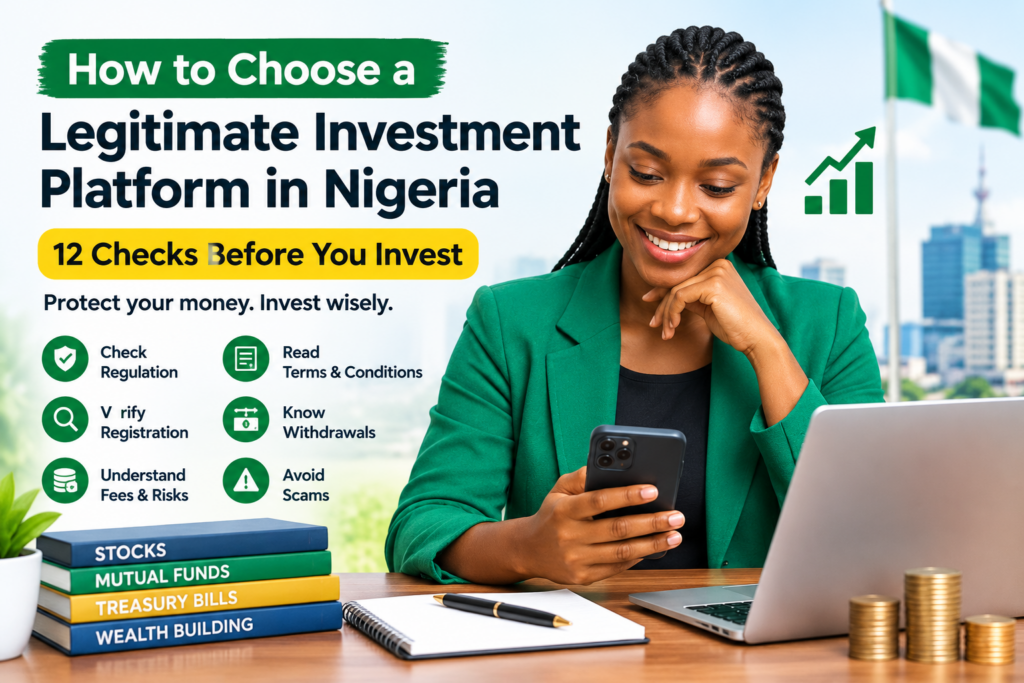
In this guide, Naija Money Guide explains 12 practical checks you can perform before using an investment platform in Nigeria.
The goal is not simply to find a platform offering the highest return. The goal is to understand who operates the platform, what regulator applies to the service, where your money goes, what you are actually buying, what fees apply, how withdrawals work and what risks you are accepting.
What Is an Investment Platform?
An investment platform is a digital or physical service that allows customers to access one or more financial or investment products.
For example, a platform may provide access to:
- Nigerian shares
- Mutual funds
- Bonds
- Treasury-related products
- Fixed-income investments
- Portfolio management
- Investment advisory services
- Other regulated capital-market products
However, the term investment platform does not automatically tell you what regulatory category the business belongs to.
Two websites may both describe themselves as investment platforms while offering completely different products and operating under different regulatory frameworks.
That is why investors should ask:
Who operates this platform, what exactly does it offer, and which regulator supervises that activity?
For capital-market activities, the SEC’s registered-operator database allows members of the public to verify capital-market operators and view information about their registration status and functions.
Why You Should Verify an Investment Platform Before Paying
One of the biggest mistakes a beginner can make is to judge an investment platform by appearance alone.
A platform may have:
- A professional website
- A modern mobile application
- Thousands of social-media followers
- Positive comments
- Influencers promoting it
- Testimonials from supposed customers
- Attractive investment graphics
None of these things, by themselves, establish that the platform is authorised for the investment activity it is offering.
The SEC’s current public notice specifically warns against unregistered online investment schemes and unrealistic or guaranteed returns.
The SEC has also published information explaining how Ponzi and pyramid schemes can appear attractive while depending on money from newer participants rather than sustainable legitimate investment activities.
Therefore, verification should come before payment, not after something goes wrong.
12 Checks to Perform Before Choosing an Investment Platform in Nigeria
1. Check the Regulator That Applies to the Product
The first question should not be:
“How much will I earn?”
It should be:
“Who regulates this activity?”
Different financial services can fall under different regulatory frameworks.
For capital-market activities, the SEC is the key regulator to investigate.
For banking-related services, the Central Bank of Nigeria (CBN) is relevant.
For certain consumer-lending activities, the Federal Competition and Consumer Protection Commission (FCCPC) has regulatory responsibilities under applicable digital-lending rules.
This distinction matters because seeing one regulator’s name on a website does not automatically mean every service offered by the company is regulated by that regulator.
For example, a company may provide several financial services through different subsidiaries or licensed entities.
Always identify the specific legal entity and specific service you are considering.
Example
Suppose an app says:
“Invest ₦100,000 and earn monthly returns.”
Do not stop at the app’s name.
Ask:
- Which company operates the product?
- What exactly am I investing in?
- Is the product a capital-market investment?
- Which regulator applies?
- Is the operator authorised for that particular activity?
That is a much safer starting point.
2. Search the SEC Registered-Operator Database
If a platform is offering a service that falls within the Nigerian capital-market regulatory framework, one of the most important checks is the SEC’s official register.
The SEC provides a Find a Registered Operator service where investors can search for capital-market operators and review information such as registration status and functions.
SEC Find a Registered Operator
Do not rely solely on a logo saying:
“SEC Approved.”
Go to the regulator’s website yourself.
Search the legal company name.
Then compare the information.
Look for:
- Exact company name
- Registration status
- Type of operator
- Authorised functions
- Other available registration information
Why the exact name matters
Imagine a platform is branded as ABC Invest, but its legal operator is ABC Capital Management Limited.
Searching only “ABC Invest” may not produce the result you expect.
You should determine the legal entity behind the platform and verify that entity.
3. Confirm That the Registration Matches the Service
Finding a company’s name in a regulatory database is useful, but it is not necessarily the end of the investigation.
You should also consider what the company is registered to do.
The SEC’s registered-operator directory contains different categories of capital-market operators, including functions such as fund or portfolio management and investment advisory activities.
Therefore, ask:
Does the company’s registered function make sense for the product being offered to me?
Example
A company might have a legitimate registration for one financial activity but advertise a completely different opportunity online.
Do not assume:
“The company is registered, therefore everything it offers is automatically approved.”
Verify the specific product and activity.
4. Understand What You Are Actually Investing In
Never invest money into something you cannot explain in simple words.
Before depositing ₦50,000, ₦100,000 or ₦1 million, you should be able to answer:
What exactly happens to my money?
For example:
- Am I buying shares?
- Am I buying units in a mutual fund?
- Am I lending money?
- Is my money being managed in a portfolio?
- Is the product a fixed-income investment?
- Is the return linked to market performance?
- Is there an underlying asset?
- How is the return generated?
The SEC advises investors to understand the nature of an investment and how the business generates the promised returns.
If the explanation sounds complicated but nobody can clearly explain where your money goes, slow down.
A useful beginner rule
If you cannot explain the investment to another person after reading the official product information, you probably need more information before investing.
5. Be Suspicious of Guaranteed or Unrealistic Returns
This is one of the strongest warning signs.
Legitimate investments can involve risk.
Market prices can move.
Businesses can perform better or worse than expected.
Interest rates can change.
Investment values can rise or fall.
Therefore, promises such as:
- “Guaranteed profit every week”
- “No risk”
- “100% guaranteed”
- “Double your money quickly”
- “Guaranteed monthly income”
- “Fixed high returns regardless of market conditions”
should receive serious scrutiny.
The SEC’s May 2026 public notice specifically warned Nigerians against unregistered online investment platforms or schemes promising unrealistic or guaranteed returns.
The SEC’s investor education material also identifies unusually high or consistently positive returns, particularly when presented as low-risk or risk-free, as warning signs that require caution.
Remember
A high advertised return does not automatically mean an investment is fraudulent.
But high return + low risk + guaranteed profit + pressure to deposit quickly is a combination that deserves extreme caution.
6. Investigate Who Owns and Operates the Business
Before transferring money, find out who you are dealing with.
Look for:
- Legal company name
- Registered address
- Customer-service channels
- Official website
- Corporate information
- Regulatory registration
- Terms and conditions
- Privacy policy
Be particularly careful if the only contact is:
- A personal WhatsApp number
- A personal bank account
- A Telegram username
- A social-media direct message
- An anonymous administrator
A legitimate business should provide enough information for customers to understand who is responsible for the service.
Bank-account warning
Suppose an investment company says:
“Pay ₦200,000 into my personal account and I will activate your investment.”
Stop and investigate.
The name on the receiving account should make sense for the transaction and the legal entity providing the service.
7. Read the Terms and Conditions Before Funding Your Account
Many investors skip the terms because they appear lengthy.
That can be a costly mistake.
Before investing, look for information about:
- Minimum investment
- Investment duration
- Fees
- Withdrawal conditions
- Early withdrawal
- Penalties
- Taxes where applicable
- Risk disclosures
- Investment management
- Dispute resolution
- Account closure
- What happens if the provider stops operating
Pay special attention to the words:
“may,” “subject to,” “not guaranteed,” “fees,” “penalty,” “lock-in,” “early withdrawal” and “market risk.”
These words can materially affect the real outcome.
8. Understand the Fees
An investment can appear attractive until you calculate the actual costs.
Possible charges may include:
- Account fees
- Management fees
- Brokerage fees
- Transaction charges
- Platform fees
- Withdrawal charges
- Administrative fees
- Performance-related fees
- Taxes or statutory charges where applicable
Do not ask only:
“What return do I get?”
Also ask:
“What do I pay to get that return?”
Simple example
Suppose you invest:
₦500,000
and your investment grows to:
₦550,000
That looks like a ₦50,000 gain.
But if applicable fees, taxes and other costs total ₦15,000, the amount you actually retain can be different.
This is why investors should examine the full cost structure instead of focusing only on the advertised return.
9. Check How Withdrawals Work
A platform may make depositing money extremely easy.
The more important question is:
How do I get my money back?
Before investing, find out:
- Can I withdraw anytime?
- Is there a lock-in period?
- How long does withdrawal take?
- Are there withdrawal fees?
- Are there minimum withdrawal amounts?
- Are withdrawals processed manually or automatically?
- What happens if the investment matures?
- Can I exit early?
- What happens during market disruption?
A complicated withdrawal process is not automatically evidence of fraud because legitimate investments can have lock-in periods.
However, you should understand the restrictions before depositing.
The SEC’s investor guidance specifically encourages prospective investors to understand the exit strategy and warns that complicated or unclear withdrawal arrangements can be a warning sign.
10. Do Not Choose an Investment Because of Social-Media Hype
Social media can be useful for discovering financial products.
It can also amplify bad financial decisions.
You may see:
- TikTok videos
- Instagram advertisements
- Facebook posts
- WhatsApp broadcasts
- Telegram groups
- YouTube promotions
- Influencer recommendations
A popular post is not the same thing as independent verification.
The SEC specifically identified social-media channels including WhatsApp, Instagram, Telegram, Facebook and TikTok among platforms where unregistered online investment schemes can be promoted.
Better approach
Use social media to discover an opportunity.
Then leave social media and verify the information through:
- The company’s official website
- The relevant regulator
- Official product documentation
- Independent financial information
- The actual legal entity behind the service
11. Avoid Recruitment-Based Investment Opportunities
Be careful when the main selling point of an investment is:
“Bring three people and earn more.”
Or:
“Your income increases when you recruit new investors.”
This can be a major warning sign.
A genuine investment should have a clear underlying economic activity or investment strategy.
The SEC explains that Ponzi schemes can pay earlier participants using capital from newer participants rather than legitimate investment profits.
That means an early participant may receive money and believe the scheme is working.
But successful payments to earlier participants do not prove that the underlying investment is legitimate.
12. Check for Regulatory Warnings Before Investing
Regulatory websites can contain warnings about suspicious or unregistered operators.
The SEC maintains investor-protection information, including a page covering known investment scams and illegal operators.
Before transferring a large amount of money, search the relevant regulator’s website for:
- The company name
- The platform name
- Regulatory warnings
- Suspension notices
- Investor alerts
- Registration information
This should be part of your normal investment research.
SEC Registration Does Not Mean an Investment Cannot Lose Money
This is an important distinction for beginners.
Regulation and investment performance are not the same thing.
A regulated investment product can still lose money.
For example, shares can fall in value.
A regulated investment fund can experience losses depending on its underlying assets.
Market conditions can change.
Therefore:
“Regulated” does not mean “guaranteed profit.”
It means the provider or activity is subject to the relevant regulatory framework.
You still need to understand:
- Investment risk
- Market risk
- Liquidity risk
- Fees
- Time horizon
- Product structure
Nigerian Example: Comparing Two Investment Offers
Imagine you receive these two offers on WhatsApp.
Offer A
Invest ₦100,000 today.
Earn 15% every month.
No risk.
Guaranteed profit.
Refer two friends and increase your return.
Offer B
Invest through a registered investment provider.
Your money is invested in a specified financial product.
Returns are not guaranteed.
Fees and risks are disclosed.
Withdrawal conditions are explained in the product documents.
Which one deserves more investigation?
Offer B has characteristics that are more consistent with transparent investment communication.
Offer A contains several major warning signs:
- Very high promised return
- Guaranteed profit
- No-risk claim
- Recruitment incentive
- Social-media promotion
This does not mean that Offer A is automatically fraudulent based on those words alone.
It means you should not send money until you have independently verified the operator and product.
What About Investment Apps in Nigeria?
Investment apps can be convenient, but an app being available in an app store does not automatically prove that every financial service associated with the app is authorised.
The app store tells you that an application has been distributed through that marketplace.
It does not replace regulatory verification.
Before using an investment app, check:
Company
Who owns the application?
Product
What exactly are you buying?
Regulation
Which regulator applies?
Registration
Can you verify the operator?
Fees
What charges apply?
Withdrawal
How do you access your money?
Risk
What could cause you to lose money?
Security
How is your account protected?
These checks are more useful than simply asking:
“What is the best investment app in Nigeria?”
There is no single investment platform that is automatically best for every Nigerian.
Your choice should depend on the product, your goals, risk tolerance, fees and the provider’s regulatory status.
Investment Platform vs Investment Product
These two terms are sometimes confused.
An investment platform is the service or provider through which you access an investment.
An investment product is what your money is actually invested in.
For example:
Platform → provides access → Investment product
The platform could provide access to a fund, shares or another product.
This distinction matters because you should evaluate both.
A professional-looking platform does not make every product automatically suitable.
Similarly, a good investment product may still be inappropriate for you if the provider, fees or access conditions do not fit your needs.
How to Compare Two Investment Platforms
Suppose you are comparing Platform A and Platform B.
Do not simply compare the advertised return.
Use a table like this:
| Question | Platform A | Platform B |
|---|---|---|
| Legal company identified? | Yes/No | Yes/No |
| Relevant regulator identified? | Yes/No | Yes/No |
| Registration verified? | Yes/No | Yes/No |
| Product clearly explained? | Yes/No | Yes/No |
| Fees disclosed? | Yes/No | Yes/No |
| Withdrawal rules clear? | Yes/No | Yes/No |
| Investment risk disclosed? | Yes/No | Yes/No |
| Guaranteed returns promised? | Yes/No | Yes/No |
| Recruitment required? | Yes/No | Yes/No |
| Official customer support? | Yes/No | Yes/No |
The platform with the highest advertised return is not necessarily the better choice.
Transparency matters.
What Nigerian Beginners Should Do Before Investing
If you are new to investing, you do not need to start with a large amount.
A sensible process is:
Step 1: Define your goal
Are you investing for:
- Emergency reserves?
- A house?
- Education?
- Retirement?
- Long-term wealth?
- A business goal?
Step 2: Build financial stability
Do not invest money that you urgently need for food, rent, school fees, medical expenses or debt repayment.
Step 3: Understand the product
Know what you are buying.
Step 4: Verify the provider
Use the relevant regulator’s official information.
Step 5: Read the fees
Understand what you will pay.
Step 6: Understand withdrawal conditions
Know how and when you can access your money.
Step 7: Consider risk
Ask what happens if the investment performs badly.
Step 8: Start appropriately
Do not risk a large percentage of your savings simply because someone promises a high return.
Where to Verify Investment Operators in Nigeria
The SEC’s official registered-operator directory is one of the most important resources for investors dealing with activities under the capital-market framework.
Verify a Capital Market Operator on the SEC Website
The SEC’s investor resources can also help Nigerians learn about investing and investor protection.
SEC Nigeria — Investor Resources
For digital lending specifically, the FCCPC publishes information and lists relating to digital money-lending operators under its applicable regulatory framework. This is relevant when a financial app combines investment-style features with lending or other services.
FCCPC Digital Money Lending Information
For banking-related questions, investors and consumers should also distinguish banking services from capital-market investments and consult the appropriate CBN information where applicable.
How to Protect Yourself From Investment Scams
Use these basic rules:
Never send money because of pressure
Statements such as:
“Offer closes in one hour.”
or:
“Deposit now or lose your slot.”
should make you slow down rather than rush.
Never share your banking credentials
Do not give strangers your:
- PIN
- OTP
- Card PIN
- Password
- Internet banking password
- Authentication credentials
A legitimate financial provider should have proper security processes.
Do not rely on screenshots
A screenshot showing someone supposedly receiving ₦500,000 does not prove that an investment is legitimate.
Screenshots can be edited or taken out of context.
Do not borrow money just to chase investment returns
If the investment loses money while the loan repayment remains due, your financial position can become worse.
Don’t put everything into one opportunity
Diversification can help reduce concentration risk, although it cannot eliminate investment losses.
What to Do If You Suspect an Investment Scam
If you believe a platform may be fraudulent:
- Stop sending additional money.
- Save transaction records.
- Save emails, messages and receipts.
- Record the website or app details.
- Identify the legal entity involved.
- Contact your bank or payment provider where appropriate.
- Contact the relevant regulator or law-enforcement authority.
- Do not send additional money to someone promising to “recover” your previous investment for an upfront fee.
The last point is important because victims can sometimes be targeted again by recovery scammers.
Related articles for Naija Money Guide
Readers should also explore these related guides on Naija Money Guide:
- How to Start Investing in Nigeria — explain investment goals, risk, diversification and different investment options.
- Your Mutual Funds in Nigeria guide — useful for readers comparing pooled investment options.
A 15-Point Investment Platform Checklist
Before depositing money, ask yourself:
- What is the legal name of the company?
- What exactly am I investing in?
- Which regulator applies?
- Can I verify the company through the regulator?
- Does the registration match the service?
- Are the investment risks clearly disclosed?
- Are returns guaranteed?
- Is the promised return realistic?
- Are there recruitment incentives?
- What fees will I pay?
- How long will my money be locked up?
- How do withdrawals work?
- What happens if I want to exit early?
- Is there an official customer-support channel?
- Have I independently verified the information?
If you cannot answer several of these questions, do not rush to invest.
Common Mistakes Nigerian Investors Make
Mistake 1: Choosing the highest return
A higher advertised return usually deserves more investigation, not automatic acceptance.
Mistake 2: Trusting influencers
An influencer may introduce a financial product, but that does not replace regulatory verification.
Mistake 3: Ignoring fees
A return percentage without the full cost structure can be misleading.
Mistake 4: Ignoring liquidity
An investment may perform well but still be unsuitable if you need the money before maturity.
Mistake 5: Investing emergency money
Your emergency fund should not normally depend on an investment that can lose value or become difficult to withdraw.
Mistake 6: Assuming regulation means guaranteed returns
Regulation does not remove market risk.
Mistake 7: Failing to diversify
Putting all your savings into one investment exposes you to concentration risk.
Mistake 8: Sending money to personal accounts
Always investigate why a supposedly professional investment business wants payment into an individual’s account.
Mistake 9: Believing testimonials are proof
Testimonials can show experiences, but they are not a substitute for regulatory and product verification.
Mistake 10: Ignoring official warnings
If a regulator has published a warning concerning an operator or type of scheme, take it seriously.
Frequently Asked Questions
What is the safest investment platform in Nigeria?
There is no single platform that is automatically the safest for every investor.
Safety depends on the specific product, provider, regulatory status, fees, risks, custody arrangements and your own financial circumstances.
For capital-market services, investors should verify the operator through the SEC’s official registration information before investing.
How can I check if an investment company is registered in Nigeria?
Start with the relevant regulator.
For capital-market operators, use the SEC’s Find a Registered Operator database.
Search for the company’s legal name and examine its registration status and authorised functions.
Are investment apps in Nigeria safe?
Some may provide legitimate financial services, but you should not assume an app is safe simply because it is available online or in an app store.
Verify the operator, product, applicable regulator, fees, risks and withdrawal conditions before investing.
Does SEC registration guarantee my investment?
No.
Registration and regulation do not guarantee that an investment will make money.
Investment values can rise or fall depending on the product and market conditions.
Are guaranteed investment returns legitimate?
A guaranteed return is not automatically proof of fraud, but investors should be extremely careful when a platform combines guaranteed or unrealistic returns with little or no apparent risk.
The SEC has specifically warned Nigerians about unregistered schemes promising unrealistic or guaranteed returns.
How do I know if an investment platform is a Ponzi scheme?
Look for warning signs such as:
- Returns that appear unrealistically high
- Guaranteed profits with little risk
- Heavy emphasis on recruiting new investors
- Unclear underlying business
- Difficulty withdrawing money
- Pressure to invest quickly
- Lack of proper regulatory registration
The SEC explains that Ponzi schemes may use money from newer participants to pay earlier participants.
Should I invest through WhatsApp or Telegram?
Do not treat WhatsApp or Telegram as proof that an investment is legitimate.
The SEC has specifically warned about unregistered investment schemes promoted through social-media and messaging platforms.
Verify the company independently through official regulatory sources.
What should I do if an investment platform asks for more money before allowing withdrawal?
Stop and investigate.
Do not automatically send additional money because someone says you must pay a “release fee,” “tax,” “activation fee” or “clearance fee.”
First verify the claim through the provider’s official channels and relevant authorities.
Is investing better than keeping money in a savings account?
They serve different purposes.
Savings can provide liquidity and stability, while investments can provide opportunities for growth but may involve risk.
Your choice should depend on your financial goal, time horizon and risk tolerance.
How much money should a beginner invest?
There is no universal amount that is right for everyone.
Start with an amount you can afford to keep invested without compromising essential expenses and financial obligations.
Understanding the investment is more important than starting with a large amount.
Can I lose all my money in an investment?
Depending on the investment, significant losses are possible.
The level of risk depends on the product.
This is why investors should understand what they are buying before committing money.
Should I borrow money to invest?
Borrowing to invest can significantly increase your financial risk because the investment can lose value while the debt still has to be repaid.
Beginners should be particularly cautious about using borrowed money for investments.
What is the first thing I should do before investing?
Identify the product and the legal entity providing it, then verify the provider through the relevant regulator.
Do not start with the promised return.
Start with verification and understanding.
Final Takeaway
Choosing a legitimate investment platform in Nigeria is not simply about finding an app that promises the highest return.
A better approach is to investigate the platform before committing your money.
Check:
- Who operates it
- What product it offers
- Which regulator applies
- Whether the operator is registered
- Whether the registration matches its activity
- How the investment generates returns
- What risks you face
- What fees you pay
- How withdrawals work
- Whether returns are being presented as guaranteed
- Whether recruitment is part of the opportunity
- Whether regulators have issued warnings
For capital-market investments, the SEC’s official registration resources should be one of your first verification points. The Commission’s current investor guidance also makes clear that Nigerians should avoid unregistered online investment schemes and be cautious of unrealistic or guaranteed returns.
The most important principle is simple:
Verify first. Understand second. Invest third.
Do not allow urgency, social-media popularity or promises of easy money to replace proper research.
A good investment decision is not necessarily the one promising the biggest return.
It is the one where you understand what you are investing in, who is providing it, what it costs, what could go wrong and how you can exit.
Disclaimer
Naija Money Guide provides general financial education and information. This article is not investment, financial, legal or tax advice and should not be treated as a recommendation to buy, sell or hold any investment. Investment products carry different levels of risk, and past performance does not guarantee future results. Regulatory status, products, fees, terms and conditions can change. Always verify current information directly with the relevant regulator and the investment provider before committing money. Never invest money you cannot afford to lose, and consider obtaining independent professional advice where appropriate.
Official Sources
- Securities and Exchange Commission Nigeria — Find a Registered Operator
- Securities and Exchange Commission Nigeria — Public Notice on Unregistered Online Investment Schemes
- Securities and Exchange Commission Nigeria — Known Investment Scams
- Securities and Exchange Commission Nigeria — Investor Education
- Federal Competition and Consumer Protection Commission — Digital Lending Regulatory Information
- Central Bank of Nigeria — official regulatory and monetary-policy information
Article reviewed: October 5, 2026