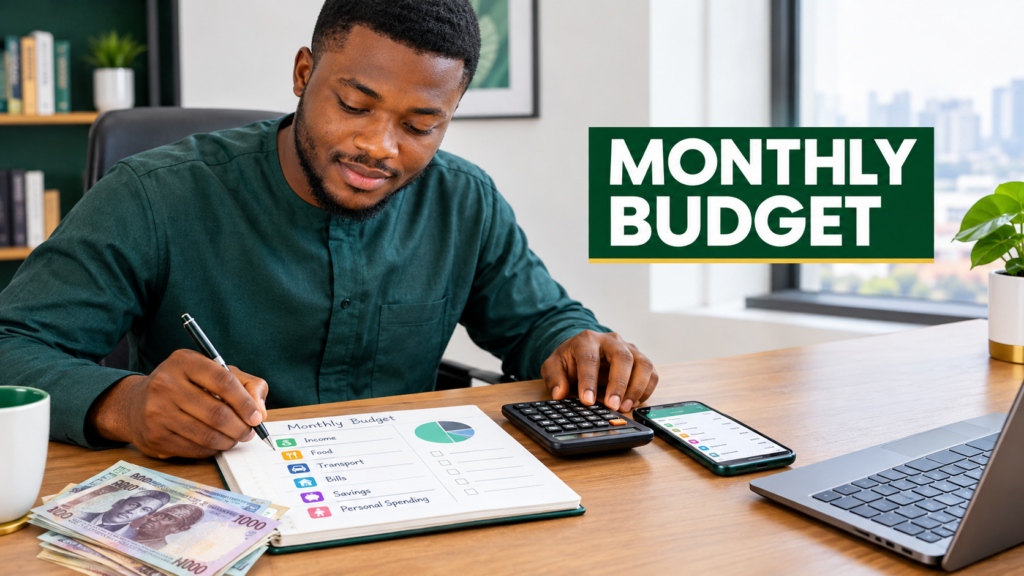
If your salary or business income seems to disappear before the end of the month, creating a monthly budget can help you understand where your money is going and plan how to use it.
A budget does not mean that you cannot enjoy your money. Instead, it gives you a plan for essential expenses, savings, debt payments and personal spending.
This guide explains how to create a monthly budget in Nigeria, including how to track your income, categorize expenses, set a savings target and create a simple budget you can use every month.
Quick answer: To create a monthly budget, calculate your income, list your expenses, separate needs from wants, set a savings target, assign amounts to each category and review your actual spending at the end of the month.
What Is a Monthly Budget?
A monthly budget is a plan showing how you intend to use your income during a particular month.
It normally includes:
- Total income
- Housing costs
- Food
- Transportation
- Electricity and utilities
- Airtime and data
- Family responsibilities
- Debt repayments
- Savings
- Personal spending
- Other planned expenses
The purpose is to make your financial decisions before the money is spent.
Why Is Budgeting Important in Nigeria?
A realistic budget can help you:
- Understand where your money goes
- Control unnecessary spending
- Save consistently
- Prepare for unexpected expenses
- Plan for large purchases
- Manage debt payments
- Avoid spending more than you earn
- Work toward financial goals
A Nigerian budget may also need to account for expenses that can vary significantly, such as transportation, food, electricity, fuel and other household costs.
This is why copying a budget designed for another country may not work for everyone.
How to Create a Monthly Budget in Nigeria
Step 1: Calculate Your Total Monthly Income
Start with the money you actually expect to receive.
Your income could come from:
- Salary
- Business income
- Freelance work
- Side jobs
- Commission
- Rental income
- Other legitimate sources
If you receive a regular salary, use your expected take-home pay rather than your gross salary when planning your everyday budget.
If your income changes every month, consider using a conservative estimate based on your recent income rather than assuming that your highest-earning month will repeat.
Example
Suppose you receive:
| Income Source | Amount |
|---|---|
| Salary | ₦200,000 |
| Side business | ₦30,000 |
| Freelance work | ₦20,000 |
| Total | ₦250,000 |
Your example monthly budget would therefore start with ₦250,000.
If the ₦30,000 or ₦20,000 is uncertain, you should not automatically depend on it for essential expenses.
Step 2: List All Your Monthly Expenses
Write down everything you normally spend money on.
Common expenses include:
Housing
- Rent
- Service charges
- Repairs
- Security-related costs where applicable
If you pay rent annually, you can divide the expected annual amount by 12 for planning purposes.
For example:
₦600,000 annual rent ÷ 12 = ₦50,000 monthly provision
This does not mean you pay the landlord ₦50,000 every month. It means you can set aside approximately that amount each month toward the future rent payment.
Food
Include:
- Groceries
- Market purchases
- Eating outside
- Food delivery
- Snacks and drinks
Transportation
Consider:
- Bus
- Taxi
- Ride-hailing
- Fuel
- Vehicle maintenance
- Other transport costs
Utilities
Examples include:
- Electricity
- Generator fuel
- Water
- Internet
- Airtime
- Data
Family and Social Responsibilities
If you regularly support family members or contribute to important events, include a realistic amount in your budget.
This is better than pretending the expense does not exist and then being surprised when it occurs.
Debt Payments
If you have loans or other debts, include the required payments in your monthly plan.
Do not create a savings target that leaves you unable to meet essential contractual payments.
Step 3: Separate Needs From Wants
One of the most useful budgeting habits is distinguishing between things you need and things you want.
Needs
These are expenses that are generally important for your basic living or obligations.
Examples:
- Food
- Housing
- Transportation
- Basic utilities
- Healthcare
- Education
- Required debt payments
Wants
These are expenses that may improve your lifestyle but can usually be reduced or postponed.
Examples:
- Entertainment
- Unplanned shopping
- Eating out
- Premium subscriptions
- Luxury purchases
- Non-essential gadgets
The distinction is not always identical for everyone.
For example, internet data might be a want for one person but an essential work expense for a freelancer.
Your budget should reflect your actual circumstances.
Step 4: Decide How Much You Want to Save
Saving should be part of the budget rather than something you only do when money remains.
Your savings could be divided into different goals:
- Emergency fund
- Rent
- School fees
- Business capital
- Major purchase
- Future plans
For example, if your income is ₦250,000 and you decide that ₦20,000 is affordable for savings:
Monthly income: ₦250,000
Savings: ₦20,000
Amount remaining for other planned expenses: ₦230,000
The right amount depends on your income, expenses, debt and responsibilities.
There is no universal savings percentage that every Nigerian must follow.
Step 5: Create Your Expense Limits
Now give each major expense a realistic limit.
For example:
| Category | Monthly Budget |
|---|---|
| Food | ₦55,000 |
| Transport | ₦25,000 |
| Electricity & utilities | ₦20,000 |
| Data & airtime | ₦10,000 |
| Family support | ₦15,000 |
| Savings | ₦20,000 |
| Personal spending | ₦15,000 |
| Debt repayment | ₦25,000 |
| Miscellaneous/buffer | ₦15,000 |
| Housing provision | ₦50,000 |
| Total | ₦250,000 |
This is an illustrative example, not a recommended budget for every person.
Your own figures should be based on your actual circumstances.
Step 6: Include a Buffer for Unexpected Expenses
A budget that allocates every naira to a fixed expense may become difficult when something unexpected happens.
Consider keeping a small buffer for things such as:
- Emergency transport
- Minor repairs
- Unexpected household expenses
- Price changes
- Urgent family responsibilities
The buffer is different from your emergency fund.
A monthly buffer is for relatively small or irregular expenses.
An emergency fund is intended for more significant unexpected financial situations.
Step 7: Track Your Spending
Creating the budget is only the beginning.
You also need to compare your plan with what you actually spend.
You can use:
- A notebook
- Spreadsheet
- Phone notes
- Budgeting application
- Bank transaction history
For example:
| Category | Budget | Actual | Difference |
|---|---|---|---|
| Food | ₦55,000 | ₦60,000 | +₦5,000 |
| Transport | ₦25,000 | ₦22,000 | -₦3,000 |
| Data | ₦10,000 | ₦8,000 | -₦2,000 |
| Savings | ₦20,000 | ₦20,000 | ₦0 |
This helps you identify where your budget needs adjustment.
Step 8: Review Your Budget at the End of the Month
At the end of every month, ask yourself:
- How much did I earn?
- How much did I spend?
- How much did I save?
- Which category exceeded its limit?
- Why did I overspend?
- Which expenses can I reduce?
- Did I have unexpected expenses?
- Should I change next month’s budget?
Your first budget does not need to be perfect.
The goal is to make it more accurate over time.
What Is the 50/30/20 Budget Rule?
You may have heard of the 50/30/20 rule.
It is a budgeting framework that broadly divides income into:
- 50% — Needs
- 30% — Wants
- 20% — Savings and debt repayment
For example, someone earning ₦200,000 could theoretically divide it as:
| Category | Percentage | Amount |
|---|---|---|
| Needs | 50% | ₦100,000 |
| Wants | 30% | ₦60,000 |
| Savings/debt | 20% | ₦40,000 |
However, this is a framework rather than a rule that everyone must follow.
If your rent and essential expenses already consume more than 50%, forcing yourself into these percentages may not be realistic.
Your budget should reflect your actual income and obligations.
How to Budget a ₦100,000 Salary in Nigeria
Here is an illustrative example.
| Category | Example Amount |
|---|---|
| Food | ₦25,000 |
| Transport | ₦15,000 |
| Utilities/data | ₦10,000 |
| Housing provision | ₦20,000 |
| Family/other obligations | ₦10,000 |
| Savings | ₦5,000 |
| Personal spending | ₦5,000 |
| Buffer | ₦10,000 |
| Total | ₦100,000 |
These amounts are only an example.
Someone living with family may have very different housing expenses from someone renting independently.
How to Budget a ₦200,000 Salary
An illustrative plan could look like this:
| Category | Example Amount |
|---|---|
| Housing provision | ₦45,000 |
| Food | ₦45,000 |
| Transport | ₦25,000 |
| Utilities/data | ₦20,000 |
| Savings | ₦20,000 |
| Family obligations | ₦15,000 |
| Personal spending | ₦10,000 |
| Buffer | ₦20,000 |
| Total | ₦200,000 |
Again, this is not a universal recommendation.
Your actual budget should be based on your living situation.
How to Budget When Your Income Is Irregular
Budgeting can be more difficult if you are a:
- Freelancer
- Trader
- Small business owner
- Farmer
- Commission worker
- Gig worker
- Contractor
Instead of assuming you will earn the same amount every month, consider creating your budget around a conservative income estimate.
For example, suppose your recent monthly income was:
- January: ₦180,000
- February: ₦220,000
- March: ₦150,000
- April: ₦250,000
- May: ₦170,000
- June: ₦200,000
You could use a conservative figure rather than automatically budgeting around the ₦250,000 month.
When you earn more than expected, you can direct some of the additional money toward savings, future expenses or other financial goals.
How to Save Money While Following a Budget
A budget can help you find areas where you can reduce spending.
Try these methods:
Plan your meals
Planning meals can reduce unplanned food purchases.
Compare prices
For major purchases, compare prices before buying.
Reduce unused subscriptions
Cancel services you rarely use.
Track small expenses
Small daily expenses can become significant over a month.
Avoid impulse purchases
Give yourself time before making non-essential purchases.
Set savings aside early
If possible, move your planned savings before discretionary spending.
Review recurring expenses
Check subscriptions, data plans, transport costs and other recurring payments regularly.
Monthly Budget Template for Beginners
You can copy this simple template:
| Category | Planned Amount | Actual Amount |
|---|---|---|
| Income | ₦ | ₦ |
| Rent/housing | ₦ | ₦ |
| Food | ₦ | ₦ |
| Transportation | ₦ | ₦ |
| Electricity/utilities | ₦ | ₦ |
| Airtime/data | ₦ | ₦ |
| Healthcare | ₦ | ₦ |
| Family obligations | ₦ | ₦ |
| Debt payments | ₦ | ₦ |
| Savings | ₦ | ₦ |
| Personal spending | ₦ | ₦ |
| Other | ₦ | ₦ |
| Total | ₦ | ₦ |
The most important thing is to record actual spending honestly.
A budget cannot help if expenses are consistently left out.
Common Budgeting Mistakes to Avoid
1. Budgeting With Money You Have Not Received
Do not depend on uncertain income for essential expenses.
2. Forgetting Annual Expenses
Rent, school fees, insurance, vehicle maintenance and other expenses may not occur every month but still need planning.
3. Ignoring Small Purchases
Small expenses can accumulate.
4. Making the Budget Too Strict
A budget that leaves no realistic room for personal spending may be difficult to maintain.
5. Forgetting Savings
If savings are never included in the budget, they may continually be postponed.
6. Using Savings for Every Unexpected Expense
Build a separate buffer and gradually develop an emergency fund where possible.
7. Copying Someone Else’s Budget
Your income, rent, family responsibilities and financial goals may be completely different from another person’s.
Budgeting vs Saving: What’s the Difference?
Budgeting and saving are connected but different.
Budgeting is the process of planning how you will use your income.
Saving is setting money aside for future use.
For example:
Monthly income → Budget → Expenses + Savings + Financial goals
A good budget can make consistent saving easier because you decide in advance how much money should be kept for the future.
Frequently Asked Questions
How do I create a monthly budget in Nigeria?
Calculate your income, list your expenses, separate needs from wants, choose a realistic savings target, assign limits to each category and review your actual spending at the end of the month.
What is the best budgeting method in Nigeria?
There is no single method that works for everyone. You can use the 50/30/20 framework, zero-based budgeting or a simple category-based budget depending on your circumstances.
How much should I save from my salary?
There is no universal amount. Choose an amount that is realistic after considering essential expenses, debt payments and other responsibilities.
How can I manage a ₦100,000 salary?
Start by identifying your essential expenses, set realistic spending limits, include a small savings target if affordable and track your spending throughout the month.
Should I save before or after spending?
If your essential expenses are covered, saving early in the month can help prevent the money from being spent elsewhere. However, your savings target should remain realistic.
How can I budget if my income changes every month?
Use a conservative income estimate and prioritize essential expenses. During higher-income months, consider putting some additional money toward savings or future expenses.
Is the 50/30/20 rule compulsory?
No. It is simply a budgeting framework. Your personal budget may need different percentages because of your income, housing costs, family responsibilities and other obligations.
Final Thoughts
Creating a monthly budget does not require complicated financial software.
You can start with a notebook, your phone or a simple spreadsheet.
The basic process is:
Know your income → List expenses → Set priorities → Save what you can → Track spending → Review and adjust.
Your budget should reflect your real financial situation rather than an unrealistic target.
If you are also working on building savings, read our guide on How to Save Money in Nigeria: 15 Practical Ways to Save More and use the two guides together: the budget helps you plan your money, while the savings plan helps you set aside money for future needs.
Disclaimer
Naija Money Guide provides general financial information for educational purposes only. This article is not personalised financial, investment, tax or legal advice. Financial circumstances differ from person to person. Always consider your own situation and verify current fees, rates, terms, requirements and regulatory information directly with the relevant financial institution or regulator before making financial decisions.
Last Updated: September 2026