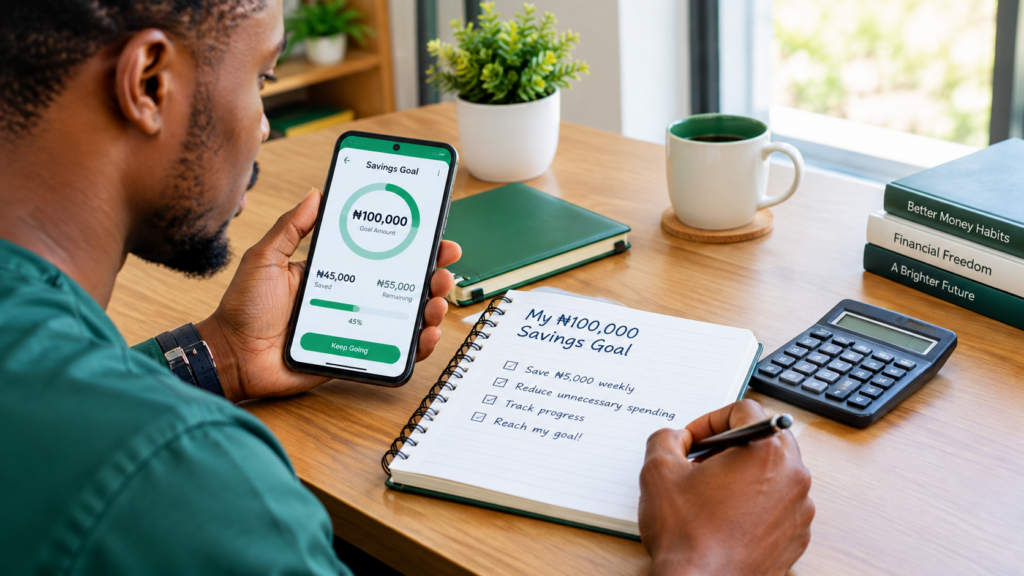
Saving ₦100,000 may seem difficult when you have regular bills, transportation costs, food expenses and other financial responsibilities.
However, breaking a large savings goal into smaller monthly or weekly targets can make it easier to understand and manage.
If your goal is to save ₦100,000 in six months, you need to put aside an average of about ₦16,667 per month.
This guide explains how to create a realistic ₦100,000 savings plan in Nigeria, including monthly targets, ways to reduce expenses and what to do if your income changes.
Quick answer: To save ₦100,000 in six months, you need to save approximately ₦16,667 per month, or about ₦3,847 per week on average. Your actual plan can use different amounts each month depending on your income.
How Much Do You Need to Save Each Month?
The basic calculation is:
₦100,000 ÷ 6 months = ₦16,666.67
You can round this to approximately ₦16,667 per month.
A simple six-month plan could look like this:
| Month | Amount Saved | Total Savings |
|---|---|---|
| Month 1 | ₦16,667 | ₦16,667 |
| Month 2 | ₦16,667 | ₦33,334 |
| Month 3 | ₦16,667 | ₦50,001 |
| Month 4 | ₦16,667 | ₦66,668 |
| Month 5 | ₦16,667 | ₦83,335 |
| Month 6 | ₦16,665 | ₦100,000 |
The final amount is adjusted slightly so the total equals exactly ₦100,000.
You can also save different amounts in different months if your income is not the same every month.
How Much Is ₦100,000 Per Week?
Six months is approximately 26 weeks.
Using 26 weeks as a planning estimate:
₦100,000 ÷ 26 ≈ ₦3,846 per week
You could therefore set a weekly target of approximately ₦3,850.
However, months do not all contain exactly the same number of weeks, so the monthly target is generally easier to track.
How to Save ₦100,000 on a Low Income
If your income is limited, saving ₦16,667 every month may not be practical.
Instead of abandoning the goal, consider combining several strategies.
1. Start With Your Current Income
Write down your average monthly income.
For example:
Monthly income: ₦120,000
Then list your essential expenses.
| Expense | Example |
|---|---|
| Food | ₦35,000 |
| Transportation | ₦20,000 |
| Bills | ₦15,000 |
| Family/personal expenses | ₦20,000 |
| Savings | ₦10,000 |
| Other expenses | ₦20,000 |
The figures are only an example. Your own budget should be based on your actual circumstances.
If you can only save ₦10,000 per month, you would save:
₦10,000 × 6 = ₦60,000
You would then need another ₦40,000 to reach the target.
That difference could potentially come from additional income or reducing selected expenses, provided doing so does not affect essential needs.
2. Reduce Unnecessary Expenses
Review your spending for the previous month.
Look for expenses that are not essential and that you can realistically reduce.
Possible areas include:
- Impulse purchases
- Unused subscriptions
- Frequent restaurant or takeaway spending
- Unnecessary transportation
- Excessive entertainment expenses
- Unplanned shopping
- Repeated small purchases
You do not need to eliminate every enjoyable expense.
The goal is to identify spending that can be reduced without making your budget unrealistic.
3. Save Extra Income
If your normal income is not enough to reach your target, consider whether you have legitimate opportunities to earn additional money.
Depending on your skills and circumstances, this could include:
- Freelance work
- Small-scale trading
- Tutoring
- Weekend work
- Selling unused items
- Providing a service you already have the skills to perform
Any additional income should be considered carefully alongside your existing responsibilities.
Avoid schemes that promise unusually high or guaranteed returns simply because you are trying to reach your savings target quickly.
4. Use a Separate Savings Arrangement
Keeping your savings separate from everyday spending can make it easier to protect the money.
For example:
Everyday money → Regular expenses
Savings money → ₦100,000 target
If you use a financial institution, check its current terms, fees, withdrawal conditions and regulatory status before depositing money.
Do not choose a financial product solely because it advertises a high return.
5. Save Immediately When You Receive Money
One common problem is waiting until the end of the month before saving.
By then, most of the income may already have been spent.
Instead, you can decide on your savings amount before spending on non-essential items.
For example, if you receive ₦100,000 and your monthly savings target is ₦15,000:
Income → ₦15,000 savings → planned expenses
The exact amount should depend on your budget.
A Flexible ₦100,000 Savings Plan
You do not have to save exactly ₦16,667 every month.
For example:
| Month | Savings |
|---|---|
| Month 1 | ₦10,000 |
| Month 2 | ₦15,000 |
| Month 3 | ₦20,000 |
| Month 4 | ₦15,000 |
| Month 5 | ₦20,000 |
| Month 6 | ₦20,000 |
| Total | ₦100,000 |
This type of plan can be useful for someone whose income varies from month to month.
The important thing is to calculate the total before starting.
What If You Miss a Monthly Savings Target?
Missing a target does not mean you have to abandon the entire plan.
Suppose your target is ₦16,667 per month but you save only ₦12,000 in one month.
Your shortfall is approximately:
₦16,667 − ₦12,000 = ₦4,667
You can review the following months and decide whether you can comfortably make up part or all of the difference.
Do not borrow money simply to make your savings challenge appear successful.
The purpose of a savings plan is to improve your finances, not create another financial obligation.
How to Save ₦100,000 From Your Salary
If you receive a regular salary, create a fixed savings target based on your income.
For example:
Salary: ₦200,000
Savings target: ₦20,000
Remaining: ₦180,000
If you save ₦20,000 for five months:
₦20,000 × 5 = ₦100,000
You could therefore reach the target in five months rather than six if your budget comfortably allows it.
However, do not copy this example if ₦20,000 would prevent you from paying essential expenses.
Should You Save Daily, Weekly or Monthly?
There is no single method that works for everyone.
Daily saving
A daily target can make a large goal feel smaller.
For example, ₦100,000 spread across roughly 180 days is about ₦556 per day.
However, saving every day can be inconvenient for people who receive income monthly.
Weekly saving
Approximately ₦3,850 per week can provide a simple way to track progress.
Monthly saving
Approximately ₦16,667 per month is easier to manage if you receive a monthly salary.
Choose the method that matches how you receive your income.
Where Should You Keep the ₦100,000?
The best arrangement depends on when you need the money and why you are saving it.
Potential options can include an appropriate savings account or another regulated savings product that you understand.
Before using a financial product, check:
- Fees
- Withdrawal conditions
- Minimum balance requirements
- Interest or return conditions
- Account restrictions
- Regulatory status
- Applicable deposit-protection arrangements
The CBN provides consumer information concerning banking services and encourages consumers to understand the terms and conditions associated with financial products. (cbn.gov.ng)
What Should You Use the ₦100,000 For?
Your savings goal should have a clear purpose.
You could be saving for:
- Emergency savings
- School expenses
- Rent
- Business equipment
- Professional training
- A planned purchase
- Family expenses
- A future financial goal
If the money is intended for an emergency fund, avoid treating it as ordinary spending money.
If the money is for a planned purchase, calculate the full expected cost before starting.
Common Mistakes When Trying to Save ₦100,000
Setting a target you cannot afford
A savings goal should not prevent you from paying essential expenses.
Borrowing to save
Taking a loan simply to reach a savings target can defeat the purpose of saving.
Keeping savings in your spending account
This may make it easier to spend the money unintentionally.
Chasing quick profits
Be cautious of anyone promising that your savings will quickly multiply with little or no risk.
Not tracking progress
Without tracking, it is difficult to know whether you are on schedule.
Giving up after one bad month
A missed target can be adjusted. Review the plan and continue.
Simple ₦100,000 Savings Tracker
You can copy this checklist into your notes:
- [ ] Month 1 — ₦16,667
- [ ] Month 2 — ₦16,667
- [ ] Month 3 — ₦16,667
- [ ] Month 4 — ₦16,667
- [ ] Month 5 — ₦16,667
- [ ] Month 6 — ₦16,665
- [ ] Total — ₦100,000
You can also create your own amounts based on your income.
Frequently Asked Questions
How much should I save each month to reach ₦100,000 in six months?
You need approximately ₦16,667 per month on average.
Can I save ₦100,000 in six months on a low income?
It may be possible depending on your income and expenses. You can combine regular savings with expense reductions or additional legitimate income, provided your essential financial obligations remain covered.
How much should I save weekly to reach ₦100,000?
Using approximately 26 weeks as a planning period, you would need around ₦3,846 per week.
What happens if I cannot save ₦16,667 every month?
You can adjust the plan. Save what you can afford and consider whether additional income or reduced discretionary spending can help close the gap.
Should I invest my savings to reach ₦100,000 faster?
Investments can involve risk, and returns are not guaranteed. If the money is needed within six months, consider the purpose and accessibility of the funds before choosing any investment product.
Is ₦100,000 enough for an emergency fund?
It depends on your essential monthly expenses and personal circumstances. For one person it may cover some unexpected expenses, while another person may need a larger reserve.
Final Thoughts
Saving ₦100,000 in six months becomes easier to understand when you break the target into smaller amounts.
The basic target is approximately ₦16,667 per month, but your actual savings plan can be flexible.
Start with your income, calculate your essential expenses, choose an affordable contribution and track your progress every month.
Most importantly, do not take on unnecessary debt simply to reach a savings target.
A sustainable savings habit is more useful than a target that puts your everyday finances under pressure.
Financial Disclaimer
This article is for general financial education and informational purposes only. It is not personal financial, investment, legal or tax advice. Financial products, fees, interest rates and terms can change. Always verify current information with the relevant regulated financial institution or official authority before making financial decisions.