
By ABDULLAHI MAGAJI
Last updated: October 3, 2026Nigeria’s economy affects almost every part of everyday financial life.
Changes in economic growth, inflation, interest rates, exchange rates, employment and business activity can affect how households manage their money, how businesses plan, and how much consumers pay for goods and services.
In 2026, Nigeria’s economic data shows a combination of economic growth, changing inflation conditions and continuing cost-of-living pressures.
The National Bureau of Statistics (NBS) reported that Nigeria’s real Gross Domestic Product (GDP) grew by 4.43% year-on-year in Q2 2026, compared with 4.23% in Q2 2025 and 3.89% in Q1 2026.
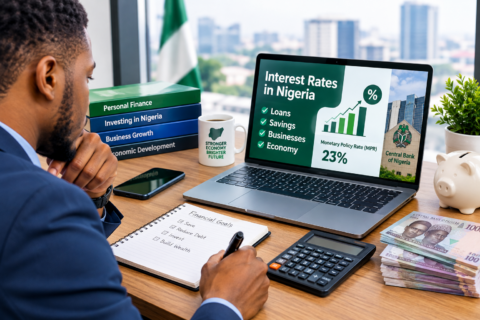
The Central Bank of Nigeria (CBN), meanwhile, set the Monetary Policy Rate (MPR) at 23% at its September 21–22, 2026 Monetary Policy Committee meeting.
This guide explains the major economic indicators Nigerians should understand in 2026 and how they can affect personal finances, businesses, savings, borrowing and investment decisions.
Important: Economic statistics change as government agencies publish new reports. The figures in this article are based on information available as of October 3, 2026. Always check the latest NBS and CBN publications when making decisions based on current economic data.
Nigeria Economy 2026 at a Glance
Here are some of the most important indicators currently available:
| Indicator | Latest figure | Period/source |
|---|---|---|
| Real GDP growth | 4.43% | Q2 2026, NBS |
| Q1 real GDP growth | 3.89% | Q1 2026, NBS |
| Q2 nominal GDP | ₦119.29 trillion | Q2 2026, NBS |
| Non-oil share of real GDP | 95.84% | Q2 2026, NBS |
| Services share of real GDP | 56.62% | Q2 2026, NBS |
| CBN MPR | 23% | Sept. 21–22, 2026 |
| Inflation | 15.39% | Current CBN/NBS published figure |
NBS’s Q2 report shows real GDP growth of 4.43%, while the CBN currently publishes an MPR of 23% and an inflation figure of 15.39% on its website.
These figures describe different parts of the economy and should not be treated as interchangeable.
Is Nigeria’s Economy Growing in 2026?
Yes.
According to the latest NBS GDP report, Nigeria’s real GDP grew by 4.43% year-on-year in Q2 2026.
This was:
- Higher than the 4.23% recorded in Q2 2025
- Higher than the 3.89% recorded in Q1 2026
The Q2 result indicates that overall economic output increased compared with the same quarter of the previous year.
However, GDP growth should not be interpreted as meaning that every household automatically became financially better off.
GDP measures economic production. It does not directly measure the income or financial situation of every individual household.
What Is GDP?
GDP stands for Gross Domestic Product.
It measures the value of goods and services produced within an economy over a particular period.
Nigeria’s GDP statistics can be reported in:
Real GDP
Real GDP adjusts for price changes and is commonly used to measure changes in economic output.
Nominal GDP
Nominal GDP measures output using current prices.
For this reason, real GDP growth and nominal GDP growth should not be confused.
Nigeria’s GDP in Q2 2026
The NBS reported aggregate nominal GDP of approximately ₦119.29 trillion in Q2 2026, compared with ₦100.73 trillion in Q2 2025.
That represented nominal year-on-year growth of about 18.43%.
Real GDP was estimated at approximately ₦53.47 trillion for Q2 2026 in the NBS series.
These figures should not be interpreted as money available to the Nigerian government or households. GDP is a measure of economic activity.
Which Sectors Are Driving Nigeria’s Economy?
Nigeria’s economy is made up of many sectors.
The Q2 2026 GDP data shows significant contributions from services, agriculture and industry.
1. Services
The services sector remained the largest contributor to real GDP in Q2 2026.
It accounted for 56.62% of real GDP and recorded real growth of 4.60% year-on-year.
Services include activities such as:
- Telecommunications
- Financial services
- Real estate
- Trade
- Transportation
- Professional services
- Education
- Other service activities
2. Agriculture
Agriculture remains an important part of Nigeria’s economy.
In Q2 2026, the agriculture sector grew by 4.39% in real terms, compared with 2.82% in Q2 2025.
Agriculture is particularly important because it is connected to food production and rural economic activity.
Agricultural performance can therefore have effects beyond GDP statistics, including potential implications for food supply and agricultural businesses.
3. Industry
The industry sector recorded 3.96% real growth in Q2 2026.
This was lower than the 7.46% recorded in Q2 2025.
Industry includes activities such as:
- Manufacturing
- Mining and quarrying
- Electricity and other industrial activities
This shows why headline GDP growth should be considered alongside individual sector performance.
What Is Happening to Nigeria’s Oil Sector?
Oil remains important to Nigeria’s economy, but the latest GDP data shows that the non-oil economy accounts for the overwhelming majority of real GDP.
The oil sector grew by 7.31% year-on-year in Q2 2026, according to the NBS report.
Oil accounted for 4.16% of real GDP, while the non-oil sector accounted for 95.84%.
The NBS also reported average daily crude-oil production of about 1.72 million barrels per day in Q2 2026, according to reporting on the Q2 GDP release.
Oil therefore remains important for government revenue, exports and foreign-exchange earnings, even though the non-oil sector represents most of measured real economic output.
What Is the Non-Oil Sector?
The non-oil sector includes economic activity outside crude petroleum and natural gas.
Examples include:
- Agriculture
- Manufacturing
- Telecommunications
- Trade
- Real estate
- Financial services
- Construction
- Professional services
The NBS reported that the non-oil sector grew by 4.31% in real terms in Q2 2026.
The sector accounted for 95.84% of real GDP during the quarter.
What Is the Current Inflation Rate in Nigeria?
The CBN currently publishes an inflation rate of 15.39% on its website.
The figure is based on Nigeria’s rebased Consumer Price Index (CPI) series.
Inflation measures the rate at which the general level of prices changes over time.
It is important to understand that:
A lower inflation rate does not necessarily mean that prices have fallen.
For example, if the price of an item rises from ₦10,000 to ₦11,000, and later rises to ₦11,500, prices are still increasing even though the rate of increase may have changed.
Why Can Nigerians Still Feel Cost-of-Living Pressure When Inflation Falls?
Inflation is a rate of price change.
It is not the same thing as the actual price level.
If food, rent, transportation and other expenses have already increased significantly, a slower rate of increase does not automatically return prices to their previous levels.
This is why households can continue experiencing financial pressure even when the inflation rate begins to moderate.
What Is the Current MPR in Nigeria?
The CBN’s latest Monetary Policy Committee meeting held on September 21–22, 2026 reset the Monetary Policy Rate to:
23%
The MPC had previously retained the MPR at 26.5% in July 2026 before the September reduction.
The MPR is a monetary-policy rate.
It is not the same as the interest rate charged on every Nigerian bank loan.
How Does the MPR Affect Nigerians?
Changes in the MPR can influence financial conditions.
They can affect the environment in which banks price:
- Loans
- Deposits
- Business financing
- Other financial products
However, a change in the MPR does not automatically mean that every bank will change every customer loan or savings rate by the same amount.
When borrowing money, check the actual terms of your loan offer.
Nigeria’s Exchange Rate and the Economy
The exchange rate is another important economic indicator.
Changes in the naira’s value against foreign currencies can affect businesses and consumers in different ways.
For example, businesses that import goods, equipment or raw materials may be affected by exchange-rate movements.
Exchange-rate changes can also influence:
- Import costs
- Production costs
- Travel expenses
- Foreign education costs
- Imported food and consumer goods
- Business pricing
The CBN currently publishes an official exchange-rate indicator on its website, but exchange rates can change frequently.
Therefore, readers should check the latest rate rather than relying on an old figure copied from an article.
How Does the Economy Affect Ordinary Nigerians?
Economic statistics can sound complicated, but they can affect everyday financial decisions.
Food
Agricultural production, transportation costs, energy costs, exchange rates and other factors can affect food prices.
Transportation
Fuel prices, vehicle operating costs, spare parts and general operating expenses can affect transport costs.
Housing
Rent and housing costs can be affected by construction costs, land prices, demand and financing conditions.
Loans
Interest rates and broader financial conditions can affect the cost and availability of borrowing.
Savings
Interest rates and inflation can affect the purchasing power and return associated with savings.
Jobs
Economic activity can affect demand for labour, although GDP growth does not automatically guarantee that every sector or worker will experience employment growth.
Nigeria Economy and Jobs
Employment is one of the most important issues for households.
However, GDP growth alone cannot tell you exactly how many jobs are being created or whether household incomes are increasing.
Employment statistics should be examined separately using official labour-market data.
For this reason, NaijaMoneyGuide recommends checking the latest NBS labour-force publications rather than using an old unemployment figure in a 2026 article.
Nigeria Economy and Small Businesses
Small businesses can be affected by economic changes through:
- Input costs
- Electricity expenses
- Transportation
- Customer demand
- Access to credit
- Exchange rates
- Taxes and regulatory costs
- Competition
A business owner should therefore monitor both the wider economy and the specific conditions affecting their industry.
For example, a telecommunications business and a farming business may experience the same national economy differently.
What Can Individuals Do During Changing Economic Conditions?
No single strategy works for every household.
However, several basic money-management practices can help people respond to changing conditions.
1. Track Your Spending
Know where your money is going each month.
2. Build Emergency Savings
Where possible, maintain an emergency fund for unexpected expenses.
3. Reduce Unnecessary Debt
Before taking a new loan, consider whether the expense is necessary and whether you can afford the repayment.
4. Compare Financial Products
Don’t accept the first savings account, loan or investment product you see.
Compare rates, fees, conditions and risks.
5. Develop Income Skills
Additional skills can potentially create more employment or business opportunities.
6. Keep Business Records
If you operate a business, monitor revenue, expenses, debt and cash flow.
7. Avoid Unverified Financial Claims
Be cautious about online promises of guaranteed investment returns, guaranteed loans or unrealistic income opportunities.
What Does Economic Growth Mean for Your Money?
Economic growth can create opportunities, but its effect differs across individuals.
For example, a growing sector may create demand for:
- Workers
- Suppliers
- Contractors
- Transport services
- Technology
- Financial services
But growth in national GDP does not automatically increase every person’s income.
Your financial situation also depends on:
- Your occupation
- Location
- Industry
- Income
- Expenses
- Debt
- Savings
- Assets
- Household circumstances
Important Economic Indicators to Watch in Nigeria
If you want to follow Nigeria’s economy, these are some of the indicators worth monitoring:
GDP
Shows changes in economic output.
Inflation
Shows changes in the general price level.
MPR
Shows the CBN’s key monetary-policy rate.
Exchange Rate
Shows the value of the naira relative to other currencies.
Employment
Provides information about labour-market conditions.
Oil Production
Important because of oil’s role in exports and public finances.
Government Revenue and Spending
Useful for understanding fiscal conditions.
Interest Rates
Important for borrowers, savers and businesses.
Nigeria Economy 2026: Key Facts
The latest available data shows:
- Real GDP grew 4.43% year-on-year in Q2 2026.
- Q1 2026 real GDP growth was 3.89%.
- Q2 2026 nominal GDP was about ₦119.29 trillion.
- Services accounted for 56.62% of real GDP in Q2 2026.
- Agriculture grew 4.39% in Q2.
- Services grew 4.60% in Q2.
- Industry grew 3.96% in Q2.
- Oil-sector real growth was 7.31%.
- Non-oil-sector real growth was 4.31%.
- Non-oil activities accounted for 95.84% of real GDP.
- The CBN’s latest MPR is 23%.
- The CBN currently publishes inflation at 15.39%.
Frequently Asked Questions
Is Nigeria’s economy growing in 2026?
Yes. NBS reported real GDP growth of 4.43% year-on-year in Q2 2026, compared with 3.89% in Q1 2026.
What is Nigeria’s GDP growth rate in 2026?
The latest quarterly figure is 4.43% year-on-year for Q2 2026.
What is the current inflation rate in Nigeria?
The CBN currently displays an inflation rate of 15.39% based on the current rebased CPI series.
What is the current MPR in Nigeria?
The CBN’s September 21–22, 2026 MPC decision set the MPR at 23%.
Does GDP growth mean Nigerians are becoming richer?
Not necessarily. GDP measures economic output. Household income, prices, employment and purchasing power are separate considerations.
Why are prices still high if inflation is lower?
A lower inflation rate means prices may be increasing more slowly; it does not necessarily mean that prices have returned to previous levels.
Which sector contributes the most to Nigeria’s GDP?
The services sector accounted for the largest share of real GDP in Q2 2026, at 56.62%.
Is Nigeria still dependent on oil?
Oil remains important to exports and public finances, but the non-oil sector accounted for 95.84% of real GDP in Q2 2026.
Where can I find official Nigerian economic data?
The National Bureau of Statistics publishes GDP, CPI and other national statistics, while the Central Bank of Nigeria publishes monetary-policy information and other financial indicators.
Final Thoughts
Nigeria’s economy in 2026 should be understood through several indicators rather than one number.
The latest GDP data shows 4.43% real growth in Q2 2026, while the CBN’s latest monetary-policy decision sets the MPR at 23%. Inflation is currently reported at 15.39% on the CBN’s published indicators.
These figures provide useful information about the economy, but they do not tell the complete story of every household or business.
For personal financial decisions, look beyond headline economic numbers.
Consider your own:
- Income
- Expenses
- Debt
- Savings
- Investment goals
- Business conditions
- Financial risks
And always check the date and source of economic statistics before relying on them.
Financial Disclaimer
This article is for educational and general informational purposes only. It does not constitute personal financial, investment, tax or legal advice.
Economic indicators, inflation figures, interest rates, exchange rates and other financial data can change as new official reports are released.
NaijaMoneyGuide does not guarantee any particular economic outcome, investment return, loan rate or financial result.
Readers should verify current information with the relevant official government agency or financial institution before making important financial decisions.
Last reviewed: October 3, 2026.