
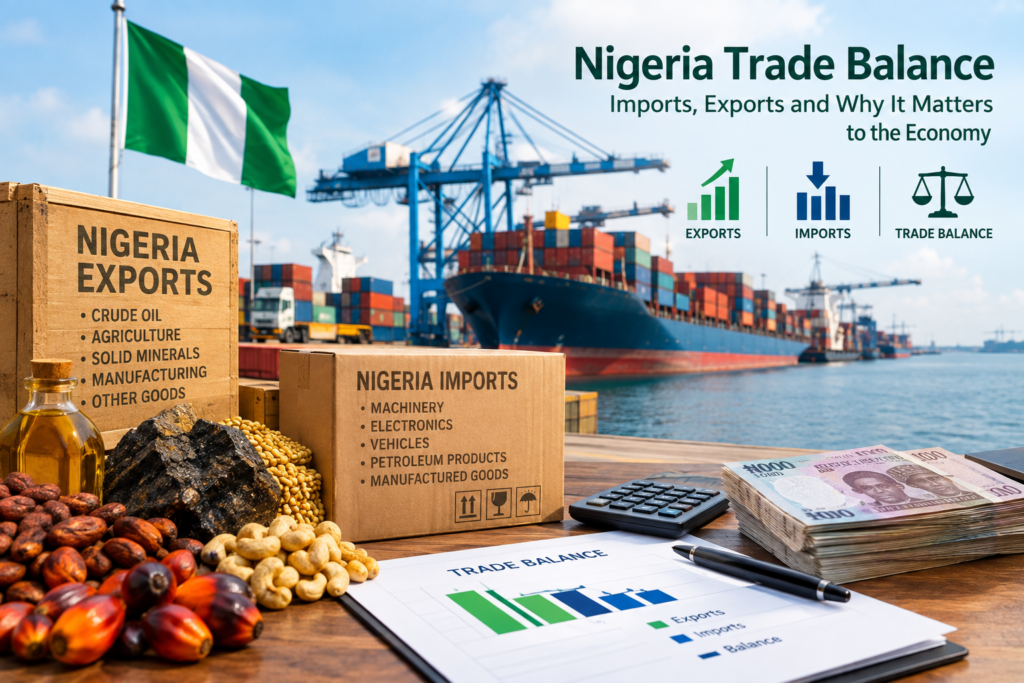
Nigeria trades with countries around the world by exporting goods and services and importing products that are produced elsewhere.
The difference between the value of a country’s exports and imports of goods is commonly referred to as its trade balance.
When exports are greater than imports, the country records a trade surplus.
When imports are greater than exports, the country records a trade deficit.
Nigeria’s trade position matters because international trade affects foreign exchange earnings, businesses, consumers, government revenue, production, employment and the wider economy.
The National Bureau of Statistics (NBS) publishes quarterly Foreign Trade in Goods Statistics covering Nigeria’s merchandise imports and exports. The latest report listed in the NBS catalogue at the time of writing is the Q2 2026 Foreign Trade Statistics Report, dated September 7, 2026.
What Is a Trade Balance?
A trade balance is the difference between the value of goods a country exports and the value of goods it imports during a particular period.
The basic formula is:
Trade Balance = Exports − Imports
For example, if a country exports goods worth $50 billion and imports goods worth $40 billion:
$50 billion − $40 billion = $10 billion trade surplus
If it exports $40 billion and imports $50 billion:
$40 billion − $50 billion = -$10 billion trade deficit
This calculation is useful for understanding merchandise trade, but it does not represent the entire balance of payments because services, investment income, transfers and financial flows are also important.
Is Nigeria’s Trade Balance Always the Same?
No.
Nigeria’s trade position changes from one period to another.
Export values can change because of:
- Crude oil prices
- Oil production
- Gas exports
- Agricultural exports
- Solid minerals
- Manufactured products
- Exchange-rate movements
- Global demand
- Production capacity
Import values can change because of:
- Domestic demand
- Machinery purchases
- Fuel and petroleum-product imports
- Food imports
- Industrial inputs
- Exchange rates
- Local production
- International prices
This means Nigeria can record a different trade balance in different quarters.
Nigeria’s Major Exports
Nigeria exports several categories of goods, but crude oil has historically played a major role in merchandise exports.
NBS data has repeatedly shown the importance of crude oil to Nigeria’s export earnings. For example, in Q4 2024, crude oil exports were valued at ₦13.783 trillion and represented 68.87% of total exports for that quarter. Non-crude oil exports accounted for the remaining share.
Other export categories can include:
Crude oil
Crude petroleum remains one of Nigeria’s major export products.
Natural gas
Nigeria also earns foreign exchange from gas-related exports.
Agricultural products
Agricultural commodities can include products such as cocoa, sesame, cashew and other crops.
Solid minerals
Nigeria has deposits of various minerals that can potentially contribute to export earnings.
Manufactured and processed goods
Increasing domestic processing can allow Nigerian businesses to export products with greater value added rather than relying only on raw commodities.
What Does Nigeria Import?
Nigeria imports a wide range of products.
Depending on the period, major import categories can include:
- Machinery
- Industrial equipment
- Vehicles
- Electronics
- Pharmaceutical products
- Chemicals
- Food products
- Refined petroleum products
- Raw materials
- Other manufactured goods
Imports are not automatically bad for an economy.
A manufacturer importing machinery, for example, may use that equipment to produce goods locally.
The important issue is understanding what is being imported, why it is being imported, how it is financed and what economic value it creates.
Why Does Nigeria Import So Many Products?
There are several reasons.
1. Domestic production may not meet demand
When local manufacturers cannot produce enough of a particular product, businesses and consumers may rely on imports.
2. Some products require specialised technology
Certain machines, medical equipment, electronics and industrial components may not be produced locally at sufficient scale.
3. Imported inputs support local businesses
Some Nigerian manufacturers depend on imported raw materials, machinery or components.
4. Price differences matter
Businesses may import products when they can obtain them at a competitive cost from international suppliers.
5. Consumer preferences influence demand
Consumers may purchase imported products because of price, availability, quality, brand recognition or product variety.
Why Do Exports Matter to Nigeria?
Exports are important because they can generate foreign exchange.
A Nigerian company selling eligible products internationally can receive foreign currency earnings.
At the national level, export receipts can support the country’s external position and contribute to foreign-exchange availability.
The CBN’s 2025 Macroeconomic Outlook reported that Nigeria’s estimated goods-account surplus increased to US$14.67 billion in 2025, compared with US$13.17 billion in 2024. It attributed the higher surplus primarily to increased export receipts. The figures were identified by the CBN as provisional staff estimates.
How Exports Can Affect the Naira
Foreign trade and the foreign-exchange market are connected.
Exporters that earn foreign currency can contribute to the supply of foreign exchange when those proceeds enter the Nigerian financial system.
Nigeria’s foreign-exchange framework has changed over time. The CBN says the Investors’ and Exporters’ window was renamed the Nigerian Foreign Exchange Market (NFEM) following reforms that unified previously segmented FX markets.
However, the relationship between exports and the exchange rate is not as simple as:
More exports = stronger naira immediately.
The exchange rate is affected by many factors, including:
- Foreign-exchange demand
- Export receipts
- Import demand
- Capital flows
- Remittances
- External reserves
- Investor activity
- Global commodity prices
- Monetary and economic conditions
Therefore, trade data is one part of a much larger economic picture.
How Imports Affect Foreign Exchange Demand
Importers generally need to pay international suppliers.
When Nigerian businesses import products from abroad, foreign currency may be required for settlement.
If demand for imports increases substantially, demand for foreign exchange can also increase.
This is one reason why the country’s import bill matters.
However, imports can also support economic activity when they involve productive goods such as machinery, industrial equipment and inputs needed by Nigerian businesses.
Are Imports Bad for Nigeria?
Not necessarily.
This is an important distinction.
An imported machine that allows a Nigerian factory to increase production is economically different from an imported consumer product that could have been competitively produced locally.
Imports can provide:
- Technology
- Machinery
- Raw materials
- Medical equipment
- Industrial inputs
- Consumer products
- Products unavailable locally
The policy challenge is therefore not simply to eliminate imports.
A stronger objective can be to improve domestic productive capacity so that Nigeria can competitively produce more of the goods it currently imports while continuing to access necessary international products and technology.
What Is Non-Oil Export?
A non-oil export is an exported product that does not come from the petroleum sector.
Nigeria has significant opportunities in non-oil exports, including:
- Agriculture
- Processed food
- Solid minerals
- Manufacturing
- Textiles
- Chemicals
- Other locally produced goods
Diversifying exports can reduce the economy’s exposure to changes in crude-oil earnings.
For example, if global oil prices fall sharply, an economy heavily dependent on oil export earnings can face pressure.
A broader export base provides additional sources of foreign exchange.
Why Export Diversification Matters
Imagine two hypothetical economies.
Economy A
Its export earnings depend heavily on one major commodity.
Economy B
Its export earnings come from:
- Oil
- Agriculture
- Manufacturing
- Services
- Minerals
- Technology-related activities
If the price of one commodity falls, Economy B has more diversified sources of external earnings.
Diversification does not eliminate economic risk, but it can reduce dependence on one source of export income.
How Trade Affects Nigerian Businesses
International trade directly affects businesses.
A Nigerian business that imports products may be affected by:
- Exchange-rate movements
- Shipping costs
- Customs-related costs
- International commodity prices
- Foreign supplier prices
- Foreign-exchange availability
An exporting business may benefit from:
- Access to larger markets
- Foreign-currency revenue
- International customers
- Greater production opportunities
But exporting also requires businesses to meet relevant standards, logistics requirements, documentation and market conditions.
How Trade Affects Consumers
You may not operate an import or export business, but international trade can still affect your household.
For example, imported components can be part of:
- Electronics
- Vehicles
- Medicines
- Food products
- Construction materials
- Household appliances
- Business equipment
Changes in international prices and exchange rates can therefore influence the prices Nigerian consumers eventually pay.
At the same time, locally produced alternatives can reduce exposure to international supply and currency pressures when they are available at competitive prices.
How Trade Can Affect Prices
International trade can affect prices through several channels.
Suppose a Nigerian company imports a product for $1,000.
If the naira cost of obtaining that $1,000 changes, the company’s import cost can change even if the international dollar price remains the same.
The company may then need to reconsider its selling price.
This does not mean every exchange-rate movement automatically produces the same percentage change in consumer prices.
Businesses also consider:
- Competition
- Inventory already purchased
- Operating costs
- Profit margins
- Demand
- Taxes and charges
- Local production costs
Trade Balance vs Balance of Payments
These terms are related but different.
Trade Balance
The trade balance focuses mainly on the difference between exports and imports of goods.
Balance of Payments
The balance of payments is broader.
It includes transactions involving:
- Goods
- Services
- Primary income
- Secondary income
- Financial flows
- Other international transactions
Therefore, a country can have a trade surplus while still experiencing pressures elsewhere in its external accounts.
This distinction is important when reading economic reports.
Nigeria’s Trade and External Reserves
Trade performance can also interact with Nigeria’s external reserves.
External reserves provide foreign assets that can support confidence in the country’s ability to meet international obligations and help the CBN manage foreign-exchange liquidity.
The CBN explains that managing external reserves is part of its mandate and that reserves can help the country meet external obligations and support confidence in monetary and exchange-rate policies.
However, reserves should not be interpreted as simply being the same thing as export earnings.
Reserves can be affected by multiple external transactions and policy actions.
What Happens When Nigeria Has a Trade Surplus?
A trade surplus means the value of exports exceeds the value of imports for the period and measure being considered.
A sustained surplus can contribute positively to external-sector strength.
But a trade surplus by itself does not mean that every Nigerian household becomes richer.
The benefits depend on factors such as:
- What Nigeria exports
- How much value is created domestically
- How export earnings enter the economy
- Government revenue
- Employment
- Investment
- Exchange-rate conditions
- Domestic prices
This is why economic statistics should be interpreted in context.
What Happens When Nigeria Has a Trade Deficit?
A trade deficit occurs when imports exceed exports during the relevant period.
A deficit is not automatically a sign that an economy is failing.
For example, a country could import large amounts of machinery and technology to expand its productive capacity.
The longer-term economic effect depends on what the imported products are used for and how the economy finances those imports.
Persistent deficits can nevertheless create foreign-exchange and external-financing pressures when they are not supported by sufficient external earnings or financing.
Why Nigeria Wants More Non-Oil Exports
Nigeria has a large population and a broad range of agricultural, mineral and human resources.
Expanding non-oil exports can potentially:
- Create new markets for Nigerian businesses
- Generate foreign exchange
- Support manufacturing
- Encourage agricultural processing
- Create employment opportunities
- Increase value added within Nigeria
- Reduce dependence on crude oil
For this to happen sustainably, businesses also need reliable infrastructure, competitive production costs, quality standards, financing, logistics and access to international markets.
What Can Nigerian Businesses Do to Benefit From Export Opportunities?
Businesses interested in exporting should first understand their target market.
Important areas to research include:
Product quality
Does the product meet the standards required by the destination market?
Packaging
Is the packaging suitable for transportation and the target market?
Documentation
Are the necessary trade and export documents available?
Logistics
How will the product reach the buyer?
Pricing
Can the business remain competitive after production, transportation and other costs?
Foreign exchange
How will payments be received and managed?
Market demand
Are customers actually willing to buy the product?
Exporting is a business activity that requires proper planning rather than simply finding an overseas buyer.
What Should Nigerians Watch When Reading Trade News?
When you see a headline saying:
“Nigeria records trade surplus”
don’t stop at the headline.
Look at:
- The period covered
- Total exports
- Total imports
- Crude-oil exports
- Non-oil exports
- Import composition
- Changes from the previous period
- Changes compared with the same period in the previous year
- The exchange rate used or reported
- Whether the figures are provisional or revised
This provides a much better understanding of what is actually happening.
How Trade Connects With Other Parts of Nigeria’s Economy
Trade should not be viewed separately from other economic indicators.
It connects with:
Inflation:
Imported goods and inputs can be affected by international prices and exchange-rate movements.
Interest rates:
Financing costs can affect businesses that import equipment or invest in production.
Exchange rates:
The cost of imports and value of foreign-currency earnings are influenced by FX conditions.
GDP:
Trade is part of the broader economic activity measured in national accounts.
Employment:
Export-oriented industries can create jobs when production expands.
Government revenue:
International trade can generate various government revenues and duties, depending on the transaction and applicable rules.
What Can Improve Nigeria’s Trade Performance?
There is no single solution.
Potential areas that can support stronger trade performance include:
- Increasing domestic production
- Improving infrastructure
- Supporting manufacturing
- Expanding agricultural processing
- Improving logistics
- Developing export-quality products
- Increasing access to international markets
- Reducing unnecessary production costs
- Supporting skills development
- Improving trade documentation and processes
- Expanding non-oil exports
These measures involve different institutions, businesses and economic conditions, so their effects can vary.
Frequently Asked Questions
What is Nigeria’s trade balance?
Nigeria’s trade balance is the difference between the value of its merchandise exports and merchandise imports during a particular period.
What is a trade surplus?
A trade surplus occurs when the value of exports is greater than the value of imports for the relevant period.
What is a trade deficit?
A trade deficit occurs when the value of imports is greater than the value of exports.
What is Nigeria’s biggest export?
Crude oil has historically been one of Nigeria’s dominant merchandise exports. NBS data for Q4 2024, for example, showed crude oil accounting for 68.87% of total exports during that quarter.
Why are non-oil exports important?
Non-oil exports can provide additional sources of foreign exchange and help diversify Nigeria’s export base beyond crude oil.
Do imports weaken the naira?
Imports can contribute to demand for foreign exchange, but the naira’s exchange rate is influenced by many factors, including export receipts, capital flows, foreign-exchange demand and supply, reserves and monetary conditions.
Are imports bad for the Nigerian economy?
Not necessarily. Imports can provide machinery, technology, raw materials, medicines and other goods needed by consumers and businesses. Their economic effect depends on what is imported and how it is used.
How does international trade affect ordinary Nigerians?
Trade can influence the prices and availability of products, business costs, employment, foreign-exchange conditions and the wider economy.
Final Thoughts
Nigeria’s trade balance is more than a number in an economic report.
It helps explain how much the country sells to the rest of the world compared with how much it buys, while also providing useful information about foreign-exchange earnings, production and external economic conditions.
Crude oil remains an important part of Nigeria’s export structure, but non-oil exports, manufacturing, agriculture, minerals and other productive sectors can play an important role in broadening the country’s sources of export earnings.
For ordinary Nigerians, trade data becomes more useful when connected to things they can see in everyday life—prices, businesses, jobs, imported products, locally made goods and the exchange rate.
Understanding these connections makes economic news easier to interpret and can help readers make better-informed personal and business financial decisions.
Disclaimer
This article is provided for general educational and informational purposes only. It is not financial, investment, legal, tax or business advice.
Economic data can be revised, and trade figures vary by reporting period. Always check the latest publications from the National Bureau of Statistics, Central Bank of Nigeria and other relevant official institutions when making decisions based on current economic conditions.
Naija money guide related articles:
- Naira Exchange Rate in Nigeria 2026: What It Means, What Affects It and How It Impacts You
- Inflation in Nigeria 2026: Meaning, Causes, Effects and How to Protect Your Money
- Interest Rates in Nigeria: How They Affect Loans, Savings, Businesses and the Economy
- Cost of Living in Nigeria 2026: Food, Rent, Transport and How to Manage Your Money